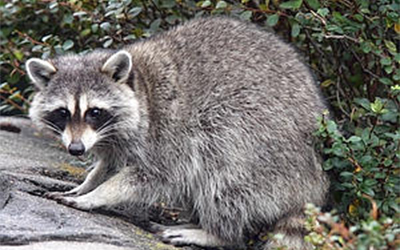
Short answer: Raccoons climb downspouts, trees and corners to reach the roof. Then they rip open the weakest spot they can find: usually a plastic roof vent, a soffit corner or an uncapped chimney. To keep them out:
- Cover vents and chimneys with heavy-gauge metal guards.
- Fix soffits and roof edges.
- Trim branches back from the roof.
- Remove food: green bins, garbage, pet food and bird seed.
How do raccoons get on the roof?
Raccoons are excellent climbers with grippy, hand-like front paws. They climb:
- downspouts and the inside corners of brick or siding
- trees and branches that overhang the roof
- fences, decks and pergolas next to a low roofline
- vines, trellises and wires.
Once they’re on a lower roof, they can usually reach the main roof from there.
The 7 most common raccoon entry points
- Roof vents. Plastic and thin aluminium box vents are the number-one entry point on Niagara homes. A raccoon pulls the cover off and widens the hole.
- Soffit corners and returns. Aluminium or vinyl soffit pushes up easily where it meets the roof.
- Roof–wall intersections. Gaps where a lower roof meets a wall or dormer.
- Chimneys. An uncapped chimney is a ready-made den, especially for mothers in spring.
- Rotted fascia and roof edges. Soft wood at the drip edge gives way under a pull.
- Gable vents. Thin louvres that raccoons can tear or push through.
- Under decks, porches and sheds. Not the house itself, but a common den right next to it.
Signs a raccoon has already got in
- Heavy walking or thumping in the ceiling at night
- Chirring or crying in spring, which means young
- A torn vent, lifted shingles or a pushed-up soffit visible from the ground
- A pile of droppings on a flat roof, deck or in the attic (a “latrine”)
- Smudges and claw marks on downspouts or corners
If you see these, read what to do if a raccoon is living in your roof.
How to keep raccoons out (what actually works)
Make the house hard to get into:
- Put heavy-gauge steel guards over plastic roof vents. Raccoons can rip plastic vents apart.
- Cap chimneys with a screened, secured cap.
- Repair or reinforce weak soffit corners, and replace rotted fascia.
- Trim branches so they don’t touch or hang over the roof.
- Screen the space under decks, porches and sheds with galvanized mesh. Bury it in an L-shape so raccoons and skunks can’t dig under.
Take away the reason to visit:
- Keep garbage and green bins in the garage or a shed until collection morning, with the lids locked.
- Feed pets indoors, and bring in bird feeders at night.
- Pick up fallen fruit, and keep compost in a closed bin.
What doesn’t work for long:
- Ammonia rags, mothballs, radios and lights may unsettle a raccoon for a night or two. A mother with young usually ignores them.
- Mothballs are a pesticide registered for clothes moths. Using them outdoors or in attics as a repellent is off-label and puts fumes into your home.
Should I trap the raccoon myself?
Usually not. In Ontario, a live-trapped animal must be released within 1 kilometre of where it was caught, within 24 hours. A raccoon released 1 km away can easily come back to the same roof. From about March to June, trapping a mother can leave her young stranded in the attic. A one-way door and a sealed entry fix the actual problem. Read more: humane raccoon removal in Ontario: laws and regulations.
Raccoon in your roof in Niagara?
Pro Wildlife Niagara removes raccoons humanely with one-way doors, checks for young and seals the entry with heavy-gauge metal. An inspection is $75–$100 plus HST and is credited toward the work. Most raccoon exclusion jobs fall between $700 and $1,500 plus HST. The smallest are around $500, and larger homes can cost more. See raccoon removal, the price guide, or call 289-273-2251.
Related: Can raccoons break through roof vents? · Raccoon removal in Niagara Falls · Why squirrels chew roof vents
Frequently asked questions
Can raccoons get into your house through the walls?
Rarely through solid walls. Raccoons look for weak building materials, not brick or solid siding. They usually get in at the roofline: plastic roof vents, soffit corners, rotted fascia, gable vents or an uncapped chimney. Once in the attic, they may move down into wall cavities or drop into a ceiling, which is when homeowners hear them in the walls.
What smell keeps raccoons away?
No smell keeps raccoons away for long. Ammonia, vinegar, pepper and mothballs may bother a raccoon briefly, but hungry raccoons and mothers with young ignore them. Mothballs used outdoors or in attics are off-label and can fume into your home. Removing food and covering vents and chimneys with metal works far better than any scent.
Will a raccoon leave on its own?
Sometimes, but rarely for good. Raccoons rotate between several dens, so one may leave for a few nights and come back. In spring, a mother won’t leave her young behind. Until the entry is sealed with metal after the animals are out, the attic stays available to the same raccoon or a new one.
Sources
- Government of Ontario, “Harass, capture or kill a wild animal damaging private property”: https://www.ontario.ca/page/harass-capture-or-kill-wild-animal-damaging-private-property (release within 1 km and within 24 hours; screen damaged vents to stop re-entry)