
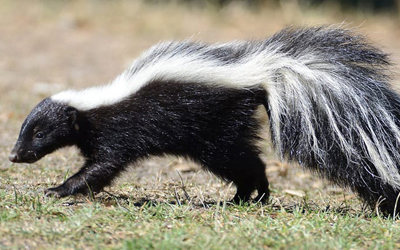

Short answer: The most common signs of a skunk in your yard are:
- small cone-shaped holes in the lawn
- a musky smell around dusk or at night
- a fresh hole or worn path under a deck, porch or shed.
To keep skunks away, remove food (grubs, garbage, pet food, bird seed). Then screen the gaps under structures with buried mesh, but only after the skunk is out.
7 signs you have a skunk in your yard
- Small, cone-shaped holes in the lawn. These are about 5–10 cm across, dug overnight where skunks hunt grubs. They’re most common in late summer and fall.
- A musky, sulphur smell at dusk, overnight or early morning, especially near the deck or shed.
- A hole or worn path under a deck, porch, shed or concrete step, often with loose soil pushed out.
- Tracks with five toes on the front and back feet and visible claw marks, in soft soil or snow.
- Droppings that look like a cat’s, often containing insect parts or seeds.
- Raided garbage or green bins. Raccoons cause more of this, but skunks will tip low bins.
- Seeing one at dusk. Skunks are mostly nocturnal. A skunk wandering in daylight, staggering or acting tame may be sick, so keep pets away and call for help.
Is it a skunk or a raccoon?
| Skunk | Raccoon | |
|---|---|---|
| Lawn damage | Small, neat cone holes | Strips of sod rolled back |
| Den | Under decks, porches, sheds, steps | Attics, chimneys, also under decks |
| Smell | Musky odour | None in particular |
| Climbing | Poor climber; stays on the ground | Climbs roofs and trees easily |
Why skunks move into Niagara yards
Niagara yards offer skunks everything they need: grubs in the lawn, fallen fruit, green bins, pet food, and dry, sheltered spaces under decks and sheds. Females look for a safe den in spring to have their young, usually in May or June. That’s when most “skunk under the deck” calls happen.
How to keep skunks away from your yard
Take away the food:
- Treat a grub problem in the lawn, because grubs are a major draw.
- Keep garbage and green bins closed and off the ground until collection day.
- Feed pets indoors, clean up fallen fruit and bird seed, and secure compost.
Close the den sites, but only when they’re empty:
- Screen the gap under decks, porches and sheds with galvanized steel mesh. Bury it in an L-shape about 30 cm down and 30 cm out, so a skunk that digs at the base hits mesh.
- Close gaps under concrete steps and around foundations.
- Keep woodpiles and clutter off the ground and away from the house.
Don’t seal a skunk in. From about May to July there may be young under the structure. Sealing them in is cruel, and the smell will be far worse. Confirm the skunk is gone first: sprinkle flour at the entrance and check for tracks leading out, or use a one-way exit.
Do repellents keep skunks away?
Not for long. Lights, radios, ammonia rags and store-bought repellents may move a skunk briefly, but a mother with young or a skunk with a good food source will stay. Don’t put ammonia or mothballs under an occupied building: the fumes can get into the house. Exclusion with buried mesh is the lasting fix.
Can I trap a skunk myself?
Ontario allows property owners to deal with wildlife damaging their property, but a live-caught skunk must be released within 1 km of where it was caught, within 24 hours, with the landowner’s permission. A trapped skunk will often spray, and trapping a mother in spring can leave her young under the deck. Most homeowners are better served by a one-way exit and buried mesh.
What if I get sprayed?
Skunk spray isn’t toxic, but it stings the eyes and can cause nausea. Read is skunk spray toxic? what it does to people and pets for first aid and how to get the smell out.
Skunk under your deck in Niagara?
Pro Wildlife Niagara removes skunks humanely from under decks, porches and sheds across the Niagara Region. We check for young, use one-way exits and install buried L-shaped mesh. Skunk jobs are quoted after an inspection ($75–$100 plus HST, credited toward the work). See skunk removal and the price guide, or call 289-273-2251.
Related: What animal is in my attic or basement? · Skunk removal in Welland
Frequently asked questions
What do skunk holes in the lawn look like?
Skunk holes are small, neat, cone-shaped holes about 5 to 10 centimetres across, dug overnight while the skunk hunts grubs. They’re scattered across the lawn rather than in strips. Raccoons, by contrast, roll back larger pieces of sod. Holes appear most often in late summer and fall, when grubs are near the surface.
How do I know if a skunk is living under my deck?
Look for a fresh hole or worn path at the edge of the deck, loose soil pushed out, and a musky smell in the evening. Sprinkle flour at the hole and check it next morning: tracks heading out mean something is using it. From May to July, assume there may be young inside.
What is the best way to keep skunks out from under a deck?
Once the skunk is out, screen the gap with galvanized steel mesh. Bury it in an L-shape about 30 centimetres down and 30 centimetres out, so digging skunks hit mesh. Remove food sources like grubs, garbage and pet food too. Never seal the gap while a skunk, or its young, could still be underneath.
Sources
- Government of Ontario, “Harass, capture or kill a wild animal damaging private property”: https://www.ontario.ca/page/harass-capture-or-kill-wild-animal-damaging-private-property (1 km / 24 h; approval not needed for skunk dens)
- UC IPM, “Skunks” (behaviour, warning signs, ammonia caution under occupied buildings): https://ipm.ucanr.edu/home-and-landscape/skunks/