
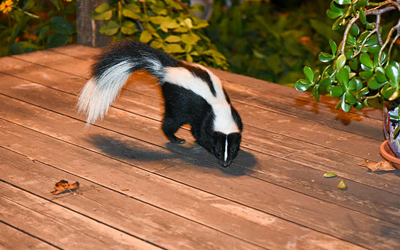
Short answer: Skunk spray isn’t a poison. For people it’s an irritant. A direct hit to the face stings the eyes so badly you may not be able to open them for a few minutes. The smell can cause nausea and headaches, and it can bother people with asthma. Effects are almost always short-term. Pets, especially dogs, need a closer watch.
What is skunk spray made of?
Skunk spray is an oily yellow liquid made mostly of sulphur-containing compounds called thiols, plus related thioacetates. It is not sulphuric acid. Thiols are what make the smell so strong; the human nose can pick them up at about 10 parts per billion. Thioacetates release more thiols when they get wet, which is why the smell returns on damp days.
A skunk stores the liquid in two glands under its tail and can aim it a few metres. Skunks usually warn first: they stamp their front feet, hiss and raise their tail.
The 3 effects skunk spray has on people
1. Eye pain and temporary loss of vision
Spray in the eyes acts like tear gas. Expect stinging, burning, redness and heavy tearing, and you may not be able to open your eyes for several minutes. That’s where the “skunk spray can blind you” idea comes from. It’s temporary. Rinse with lukewarm water for 15 minutes and get medical care if pain, redness or blurred vision continues.
2. Nausea, headache and that “sick” feeling
At high concentration, such as a direct hit or a skunk spraying under your deck or near an air intake, the smell can cause nausea, retching and headaches. These symptoms come from the odour itself and usually fade once you’re in fresh air. They aren’t a sign of poisoning.
3. Breathing irritation
Breathing in a strong cloud of spray can irritate your throat and lungs and cause coughing. In people with asthma, the odour can occasionally trigger symptoms. Anyone who is wheezing, short of breath or has chest tightness should get out of the area and seek medical advice.
Can skunk smell make you sick in your house?
It can make you feel sick: nauseated, headachy, with watery eyes, especially in a closed house right after a skunk sprays close by. It doesn’t poison you, and the symptoms ease as you air the house out. If a strong smell keeps coming back indoors, a skunk may be living under your deck, porch or crawlspace.
Is it bad to breathe in skunk smell?
Breathing in the normal smell that drifts through a neighbourhood isn’t harmful. Breathing concentrated spray up close can irritate your nose, throat and lungs and may trigger asthma. Open windows, run fans and leave the room until the air clears. Get medical help for ongoing coughing or trouble breathing.
Can skunk spray kill you?
No. Poison control centres classify skunk spray as an irritant. In people it usually causes nothing more than short-term eye, nose and throat irritation and nausea. The real risks around skunks are a bite or scratch, because skunks can carry rabies, and severe reactions in pets. Neither has anything to do with the smell.
What about dogs and cats?
Dogs get sprayed most often, usually in the face. Expect drooling, squinting, sneezing and sometimes vomiting. Rinse the eyes with water and call your vet if they stay red. Very rarely, heavy exposure damages a dog’s red blood cells. See a vet right away if your pet becomes weak or lethargic, has pale or brown gums, or has dark urine in the hours or days after being sprayed.
Does skunk spray carry rabies?
No. Rabies isn’t spread by skunk spray; it’s spread through a bite or scratch, or saliva in a wound or mucous membrane. Skunks are one of the animals that can carry rabies in Ontario, though. If a skunk bites or scratches a person or pet, wash the wound with soap and water and call Niagara Region Public Health.
How do I get skunk smell off my skin or my dog?
Use the hydrogen peroxide mix recommended by poison control:
- 1 litre (about 1 quart) of 3% hydrogen peroxide
- ¼ cup of baking soda
- 1 teaspoon of liquid dish soap
Mix it just before you use it; it only works fresh, and you should never store it in a closed container. Work it into the skin or fur for about 5 minutes, avoiding the eyes and mouth, then rinse and repeat if needed. It can lighten dark fur.
Tomato juice doesn’t neutralize the smell. Your nose just gets used to it.
How do I get skunk smell out of my house?
Ventilate first, then neutralize. Ventilation removes the smell from the air. Oxidizers break down the thiols stuck on surfaces.
- Air it out. Open windows and run fans to push air outside. If the smell came in through the furnace or air conditioner, run the fan and change the filter.
- Find the source. The smell is strongest near where the skunk sprayed: a basement window, crawlspace vent, deck or porch.
- Wash fabrics. Wash clothing, bedding and pet beds in hot water with a heavy-duty detergent. Some people add ½ cup of baking soda or a cup of white vinegar to help.
- Hard, non-porous surfaces: about 1 cup of household bleach in 4 litres (1 gallon) of water, if the surface can handle bleach. Never mix bleach with ammonia or vinegar.
- Carpets and upholstery: use a steam cleaner or a commercial enzyme or oxidizing skunk-odour product.
- Give it time. Outdoors the smell fades within days. Indoors, a faint smell can come back on humid days for a while as leftover thioacetates break down.
Bowls of vinegar or coffee grounds can mask a weak smell, but they don’t remove the source.
What if the smell keeps coming from under my deck or porch?
A smell that keeps coming back in the same spot usually means a skunk is denning under a deck, porch, shed or crawlspace. Don’t block the hole while it might be inside. From about May to July a mother may have young in there. A one-way exit lets the skunk leave, and then a screen buried in an L-shape stops it from digging back in. See our skunk removal service and how to tell if you have a skunk in your yard.
When should I get medical help?
- Eye pain, redness or blurred vision that lasts after 15 minutes of rinsing
- Wheezing, ongoing coughing or shortness of breath, especially with asthma
- Any skunk bite or scratch: wash it and call your doctor or Niagara Region Public Health
- Questions about exposure: the Ontario Poison Centre at 1-800-268-9017. For an emergency, call 911.
Skunk under your deck in Niagara?
Pro Wildlife Niagara removes skunks humanely from under decks, porches and sheds across the Niagara Region, then screens the gap so they can’t dig back in. Skunk jobs are priced after an inspection ($75–$100 plus HST, credited toward the work). See the wildlife removal price guide or call 289-273-2251.
Related: Skunk removal in Welland
Frequently asked questions
Is skunk spray toxic to humans?
Skunk spray is classed as an irritant, not a poison. It’s a mix of sulphur compounds called thiols and thioacetates. Close up, it can sting the eyes, irritate the nose and throat, and cause nausea or headaches, but these effects are short-term for healthy people. Rinse exposed eyes with water and get help if symptoms continue.
Can skunk smell make you sick in your house?
Yes, it can make you feel unwell for a short time. A strong indoor skunk smell can cause nausea, headaches and watery eyes, especially in a closed room. It isn’t poisoning, and symptoms ease once you ventilate. If the smell keeps returning, a skunk may be denning under your deck, porch or crawlspace.
Can skunk spray blind you?
Not permanently. Spray in the eyes works like tear gas. It causes intense stinging, tearing and redness, and you may be unable to open your eyes for several minutes. Rinse with lukewarm water for 15 minutes. If pain, redness or blurred vision continues after rinsing, see a doctor or go to urgent care.
How long does skunk smell last?
Outdoors, a skunk smell usually fades within a few days. On skin, fur and fabrics it lasts until it’s neutralized with a fresh peroxide mix, a hot wash or an odour product. Indoors, a faint smell can return on humid days for a few weeks as leftover compounds break down.
Does tomato juice get rid of skunk smell?
No. Tomato juice doesn’t break down the thiols in skunk spray; it only makes your nose stop noticing them for a while. A fresh mix of 3% hydrogen peroxide, baking soda and dish soap actually neutralizes the smell on skin and fur. Keep it out of eyes and mouths.
Sources
- Poison Control (National Capital Poison Center), “What happens if a skunk sprays me?” https://www.poison.org/articles/what-happens-if-a-skunk-sprays-me-213 (irritant classification; eye, breathing and nausea effects; peroxide recipe; bleach for objects; dog red-blood-cell effect)
- W. F. Wood, Humboldt State University, “Skunk Spray” and “Chemical Components” (archived): https://web.archive.org/web/20111003071953/http:/users.humboldt.edu/wfwood/skunkspray.shtml · https://web.archive.org/web/20101008140758/http:/users.humboldt.edu/wfwood/chemofskunkspray.html (thiols/thioacetates; tear-gas effect; detection around 10 ppb; dampness reactivates the smell)
- W. F. Wood, “New components in defensive secretion of the striped skunk”, J Chem Ecol 1990: https://pubmed.ncbi.nlm.nih.gov/24264006/
- University of Nebraska–Lincoln Extension, “Removing Skunk Odor” (G2100): https://extensionpubs.unl.edu/publication/g2100/2011/html/view (rabies isn’t transmitted through skunk musk)
- Ontario Poison Centre: https://www.ontariopoisoncentre.ca/ (1-800-268-9017)
- Government of Ontario, “Harass, capture or kill a wild animal damaging private property”: https://www.ontario.ca/page/harass-capture-or-kill-wild-animal-damaging-private-property (1 km / 24 h release rule)